
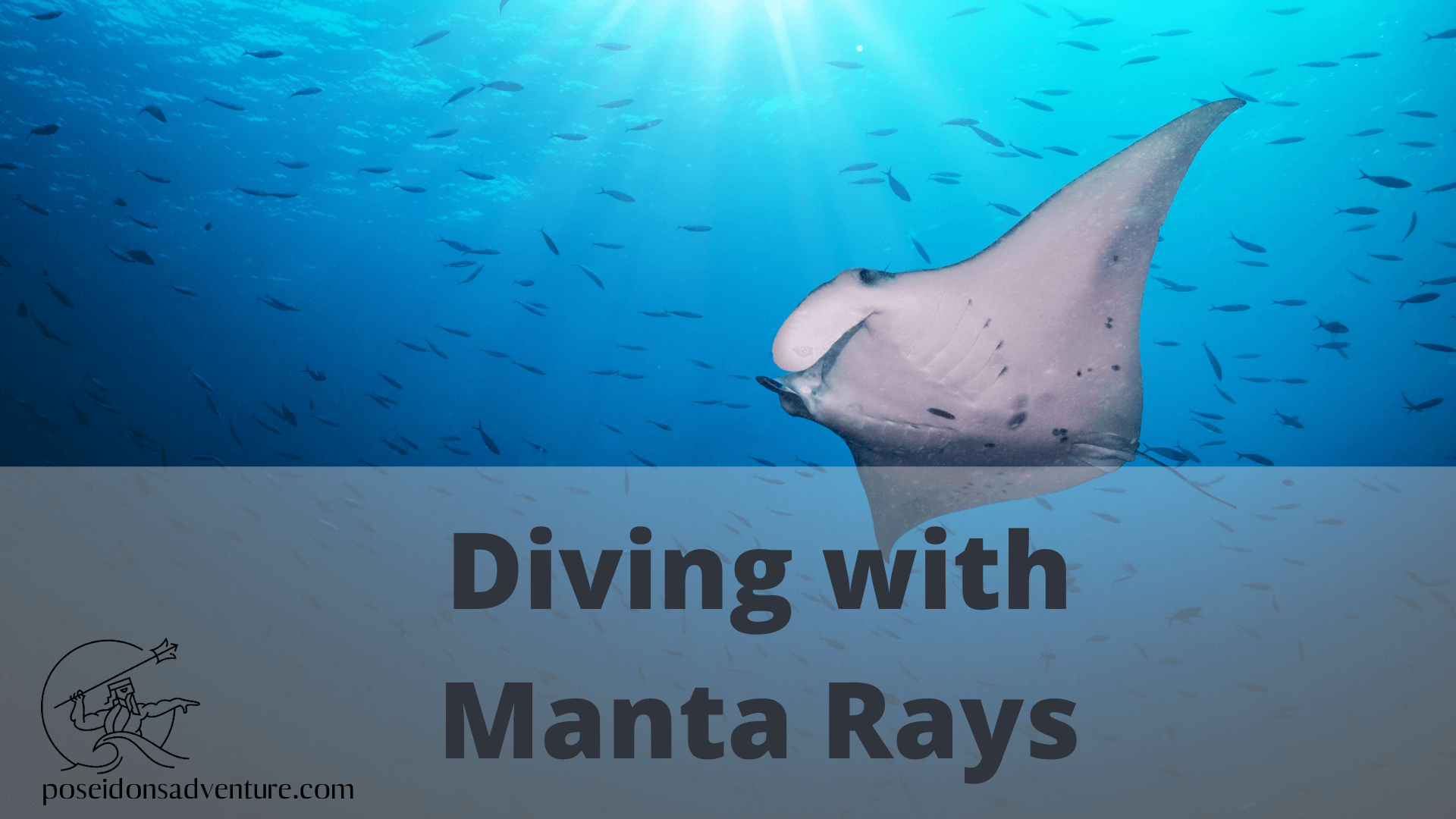
Have you experienced the feeling of diving with manta rays?
For me, Manta Rays are the Angels of the Sea. The most graceful animals in our oceans. Animals you could fell in love with them at first sight.
If you can go Diving with Manta Rays do it, it will be an unforgettable experience that will stay with you for very long time. The sight of this graceful animals is something out of this world and everyone should try to go diving with manta rays al least once. It’d make easier to understand why we need to protect them.
Manta Rays Life
Manta rays can live up to 50 years, or at least that’s what its believed, and they don’t reach maturity until they are between 8 and 10 years old. Once the female is pregnant, the gestation period goes for 12-13 months before they give birth to a single fully grown baby manta ray That can only happen once every two to 5 years.
That makes this species very vulnerable to overfishing, since they only have one pup at a time, with long gestation periods, long intervals between pregnancy and a late maturity age.
We need to protect this gentle giants before it is too late.
Diving with Manta Rays?
You can find reef mantas mainly around coastal areas in tropical and subtropical waters mostly in the Indo-Pacific. With Maldives, Indonesia and Micronesia having the biggest aggregation spots.
As for Oceanic Mantas their distribution its much bigger. You can fn them in the Northern Hemisphere, it has been recorded as far north as southern California and New Jersey in the United States, Aomori Prefecture in Japan, the Sinai Peninsula in Egypt, and the Azores in the northern Atlantic. In the Southern Hemisphere, it occurs as far south as Peru, Uruguay, South Africa, and New Zealand With Ecuador having the biggest recorded population of around 650 individuals.
How to differentiate between the two species?
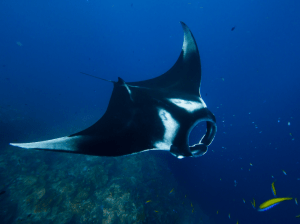
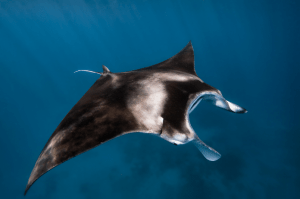
The main difference between the two species is the size of adults, as the Oceanic Manta grows much larger than the Reef manta. However, if the ray is young this can bring confusion. The only way to be sure is by comparing the color pattern. Both have dark dorsal sides, but the white lines on their back make different shapes. The Reef Manta ray has the transition between white and black markings on dorsal surface blurred along color boundary forming more of a ‘V’ in black. Whereas the giant, or oceanic, manta ray has a more well shaped “T” mark.
What do they eat?
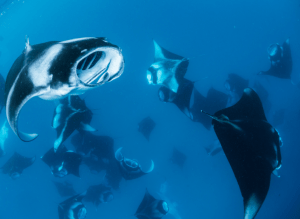
Mainly they will look for upwelling currents bringing large amount of zooplankton to the surface, hence that many time we observe this gentle giants in a kind of murky water, where the aggregations of plankton are the biggest. But the Oceanic mantas are also known to feed on smaller fish, following bait balls and feeding on them in the open ocean.
What are the threats for them?
Due to their large size and speed, they have few natural predators, occasionally big sharks such as Great Hammerheads, or Tiger sharks will attack them trying to take a bite off them, and Killer whales are know to target big rays too.
But the real threat to them are the fisheries, as they have been targeted due to their gill plates, which are quite a demand on the traditional Chinese Medicine market.
The oceanic and reef manta ray, are considered to be vulnerable by the IUCN’s Red list of Endangered species. The population has decreased drastically over the last twenty years due to overfishing.
Whatever the type of fishing (artisanal, targeted or bycatch), the impact on a population which has a low fecundity rate, a long gestation period with mainly a single pup at a time, and a late sexual maturity can only be seriously detrimental to a species that cannot compensate for the losses over several decades.
Have you ever dived with Manta Rays before?
If so let me know down below where and when, and if you have some photos of their underbelly you could take a minute and upload them at www.mantatrust.com so they could check if the manta ray has been identified or if its an unknown individual, due to the specific underbelly pattern, which is like our fingerprints, we can identify individuals and try to see where they move to, that way it will be easier to protect their frequented areas and stop overfishing.
If you like to know more abut this beautiful animals, drop me a message and I will try to help you with your questions.
Thank you for coming over, and I’ll see you all in the blue!
Join my community and discover beautiful ocean stories